
Which lift should I choose?
Five things you need to know before you hire a lift.
Five things decide which lift you need: how high you're going, how far out, whether you have to go over something, how much space there is, and whether your car can tow it. Here are all five, with figures from the lifts we rent out.
Short answer
| Painting, washing or replacing gutters on the house | Trailer lift, 10–21 m |
| Tight, steep or soft ground around the house | Tracked lift, 12 or 18 m |
| Inside a hall, warehouse or shop | Scissor lift or mast lift, 5–12 m |
| Building site with uneven ground | Rough terrain scissor lift, 12–15 m |
| Large buildings, long days in the platform | Boom lift, 16–40 m |
Outreach calculator: will the lift reach?
Enter how far out and how high you need to work. Outreach is measured from the centre of the lift, and the outriggers stick out about 2 metres on each side.
Working height is where your hands reach, approx. 2 m above the platform floor. The working area is read from the manufacturers' own working range charts (Dinolift and Omme Lift) for one person in the platform, and rounded. With two people and tools, the lift reaches less. We always check against the lift's own chart before you hire. Tap a lift in the table to see its working area.
1. Working height: how high do you need to go?
Lifts are specified by working height. That's the height of the platform floor plus about 2 metres, i.e. how high an adult can reach with their arms.
- 10 m working height = platform floor at approx. 8 m
- Measure the highest point you'll be working at, not just the gutter
- Add a little extra if the lift can't stand right up against the wall (see point 2)
Our trailer lifts range from 10.5 to 21 metres working height.
2. Outreach: how far out do you need to go?
Outreach is measured from the centre of the lift outwards. It's what people most often get wrong.
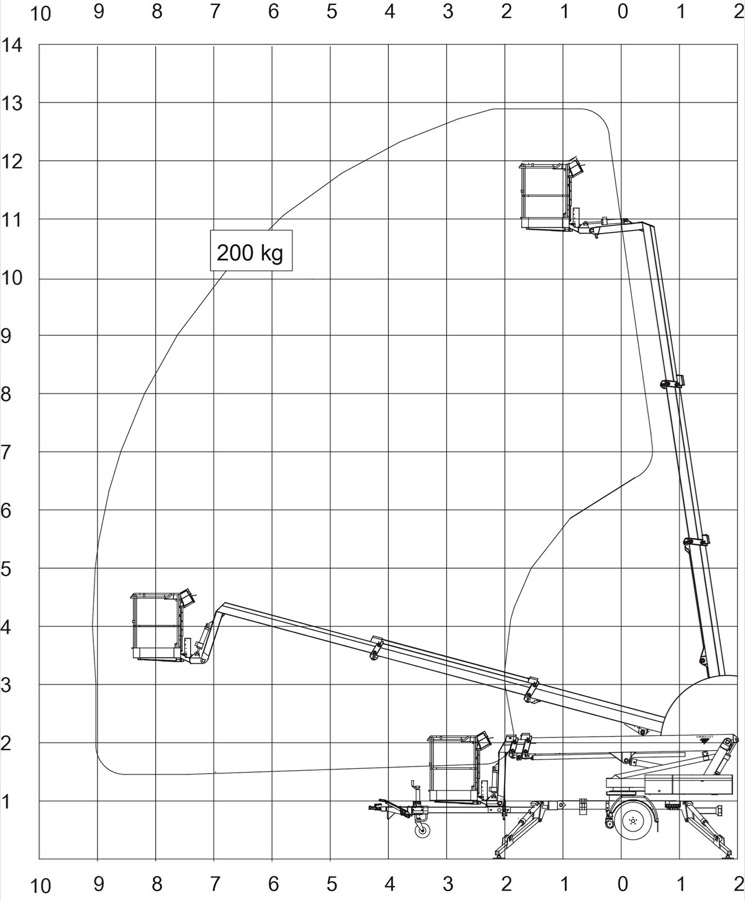
The lift can't reach full height and full outreach at the same time. The further out the platform goes, the lower it gets. The chart shows this: the Omme 1300 reaches 12.8 m straight up, but only around 5–6 m up when fully out at 9 m.
If the lift has to stand 4–5 metres from the wall because a terrace, a flower bed or a slope is in the way, you'll often need a bigger lift than the height of the house suggests.
3. Straight boom or articulating boom?
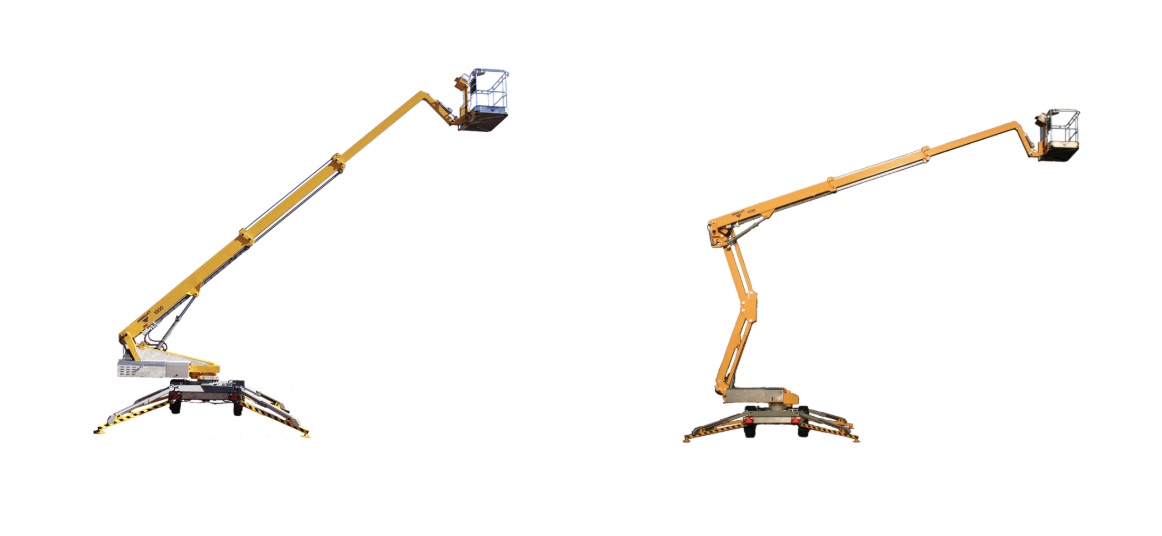
Straight boom (telescopic) goes straight out from the base. It's the simplest and lightest, and does the job when you can stand clear in front of the wall.
Articulating boom first goes about 6 metres straight up, then out. That's the one you need when you have to go over something: a terrace, an extension, a carport or a roof.
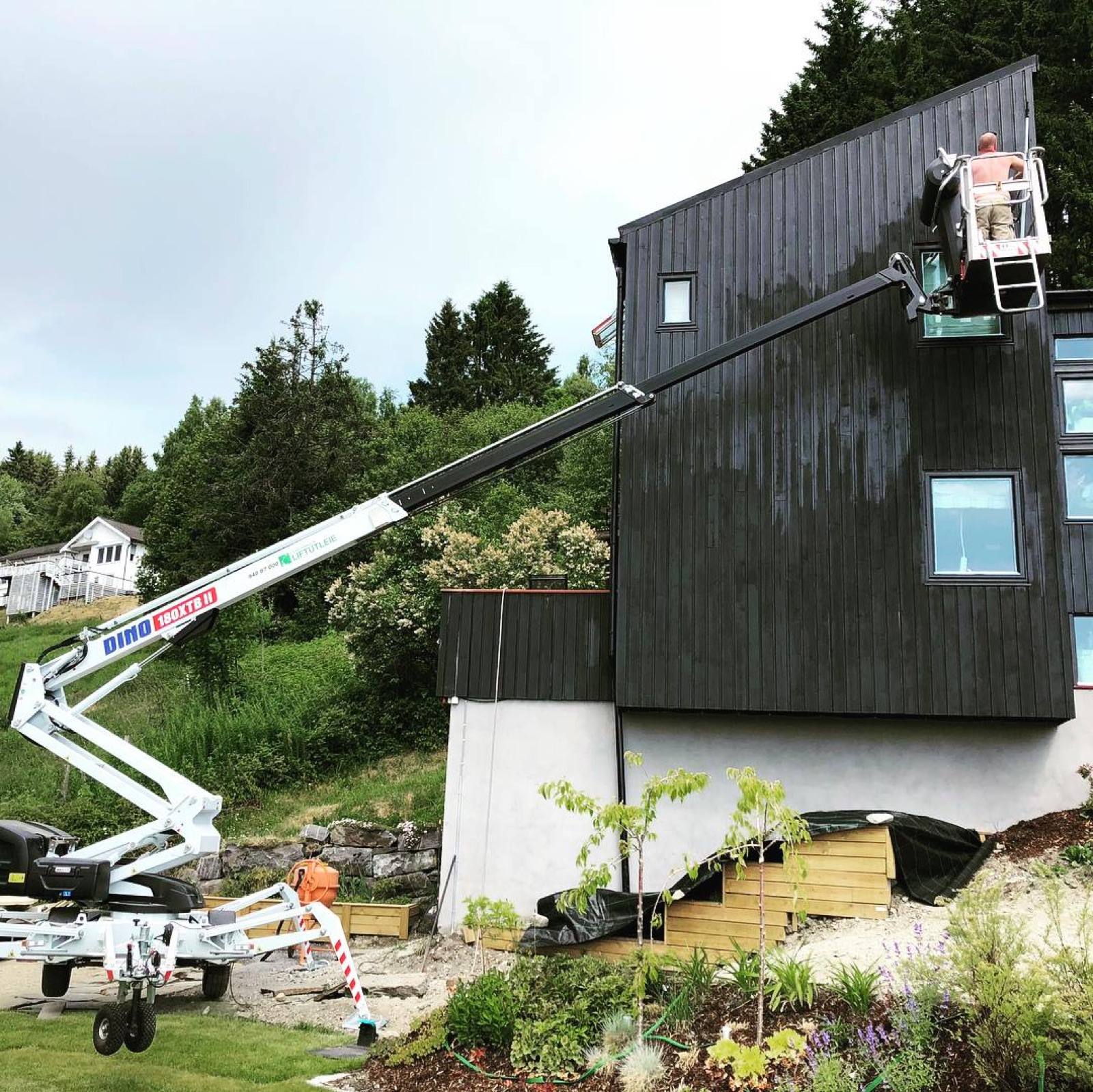
The Dino 105TL has a straight boom. The Dino 180XTB has an articulating boom.
4. Space: can the lift stand safely?
A trailer lift has to stand on flat, firm ground with the outriggers out. Measure up before you order:
- Width in transport: 1.5–1.95 m, so it gets through most gates
- Length: 5.5–7.9 m including drawbar
- With the outriggers out: 3.5–4.3 m wide, so leave space on both sides
If it's steep, soft or tight, a tracked lift is often the answer. It runs on tracks where wheels would dig in, and the Jibbi lift levels itself on sloping ground.
Indoors, the width of the doors is what decides. The narrowest mast lifts and scissor lifts are 75–81 cm and fit through standard doors.
5. Can your car tow it?
Our trailer lifts weigh from 950 kg (10 m) to 2,590 kg (21 m). There are two things you need to check:
- The car: the permitted braked trailer weight is stated in the vehicle registration document.
- The driving licence: with a class B licence you can only tow more than 750 kg if the permitted gross weight of car and trailer combined is no more than 3,500 kg. With code 96 the limit is 4,250 kg. With class BE the trailer can weigh up to 3,500 kg.
The Norwegian Public Roads Administration (Statens vegvesen) has a trailer calculator that works out whether your car can tow it. If it can't, we'll deliver the lift.
Lift types
Trailer lift
10–21 m. For homeowners and tradespeople painting, washing or maintaining houses and cabins. Can be collected with an ordinary car.
Tracked lift
12 and 18 m. When it's tight, steep or soft, or when the lift has to get through a narrow gate or across the lawn.
Scissor lift
7.5–12 m indoors. Large platform with room for people and materials. Goes straight up on a flat floor.
Rough terrain scissor lift
12–15 m. Four-wheel-drive scissor lift for building sites and gravel.
Mast lift
5–10 m. Narrow and light, for one person indoors. Fits through standard doors.
Boom lift
16–40 m. For building sites and large buildings, where people work in the platform all day. Driven from the platform.
Questions about choosing a lift
How tall a lift do I need for a two-storey house?
For gutters and walls on an ordinary two-storey house, a 10–13 metre trailer lift is usually enough. If you need to reach the ridge on the gable end, or the lift has to stand some distance from the wall, you should go up to 16 metres.
What's the difference between working height and platform height?
Working height is the platform height plus about 2 metres, i.e. how high a person in the platform can reach with their arms. A lift with a 10-metre working height has its platform floor at around 8 metres.
Can I collect the trailer lift myself?
Yes, if your car and driving licence allow the weight. Our trailer lifts weigh from 950 kg (10 m) to 2,590 kg (21 m). Check the permitted trailer weight in the vehicle registration document. Otherwise we'll deliver the lift to you.
Do I need a course to hire a lift?
You get 10–30 minutes of instruction when you collect the lift, and it's included in the price. If the lift is to be used at work, the employer often requires documented training. For that we run lift courses in classes A, B and C.
What should I do if I'm unsure which lift to choose?
Call +47 948 87 000 and describe the job: how high, how far out, and what it looks like around the house. Then we'll find the right lift together.
Still unsure?
Call +47 948 87 000 and tell us how high and how far out you need to go, and what it looks like around the house. Then we'll find the right lift together.